Photorealism in Project Scarlet Rain Radiator Model - 1026 polys, 2 x 1024x1024 diffuse textures Radiators are common heating devices used indoors. They are available in almost every household, and so are a very common asset within the game. This means that the radiator asset within the game is going to be seen multiple times in different places, so it has to be both detailed enough that it sits well with multiple backgrounds while being memory-efficient enough that using it in high numbers won't crash the game. This radiator model was based on one of the most commonly found real life radiators available in Turkey.
Project Scarlet Rain Update Creating the Villains Part Two The Sanitators When The Stranded fail, Sanitators take over. Sanitators are trained agency hitmen disguised as city workers. They wear protective masks and suits that will keep the locals away from them, and cover their weapon caches with warning tapes. The leader of the Sanitators wears the green variant of the worker suit, and is believed to know Scarlet, the protagonist, from before he became an outlaw. Sanitators don't idly wait around. They usually patrol certain structures of interest, and are much more skilled then Stranded units. Their field of vision and reaction time are off the charts, and so is their rate of fire & accuracy. They carry compact pistols which they conceal underneath their worker suits, and don't have to stop and reload after each shot. Sanitators work in pairs, and attacking them without a plan is suicide. Their weapons can be picked up after a shootout, and some will even carry flares. Though not SOP(standard-operating-procedure), some Sanitators carry explosives that can be shot off their rigs to kill the pair. Some will prime these explosives near death in an attempt to take out their aggressors, so engaging them at medium to longer distances is advised. Sanitators can be located by listening for their breathing sounds; the masks they wear force them to control their breathing at all times while giving away a loud noise. Creating the mask for a Sanitator;
It all starts with the half-loop that forms the breather part.
The breather is completed
Secondary characteristic parts that won't bend are modeled seperately.
Basic Topology is formed around the eyes/nose region
Topology continued
Rough version of the model is prepared
Basic colors are assigned and a clean uvw unwrapping procedure is applied. This takes the bulk of the time.
Basic Texture is generated.
A High-Polygon version of the mask is sculpted in Zbrush and Normal Map is generated. The second iteration of this sculpt is used as actual in-game model.
The Basic Texture is further iterated on.
The in-game model is imported into Unity and assigned the proper textures/shaders. The eyes are not done, they will have a transparent glint that lets you vaguely see the wearer inside.
Monday, April 8, 2013
Project Scarlet Rain Update Creating the Villains Part One The Stranded/The M. Schuler International Shelter Service (aka ISS) Some of the most common enemies Scarlet will face in his journey are The Stranded. These people are homeless men who've been provided shelter by the ISS, a subdivision of the very Private Military Corporation that Scarlet is evading. The ISS is used by the PMC as a means of laundering money and showing off. An expensive, international ad campaign. The ISS also uses some of the cold war's brainwashing techniques on selected Stranded to create "Assets". Assets have no memory of their training, and if caught, they have no connection with whichever agency assigned them. The ISS, acting on four continents, trains and deploys assets wherever they can. The Assets/Stranded live their lives on the street as usual. However, should the event call for it, they are activated during their visit to the Shelter. With their daily food and medical supplies, they get their disposable gear and target info. From then on, they'll fight as mindless puppets, low on intelligence but high on courage to eliminate their target, without conscience, without regret or remorse. And should they conclude their assignments, they will have no memory of it. Stranded wear the hoodies and cargo pants provided from the Shelter, and have the Shelter logo in the back of their clothing. They're usually found sleeping or talking to themselves, and will not notice Scarlet if the player is careful enough not to make noise. Upon making noise or engaging them, they will furiously attack with zip-guns made from materials that can be found in just about every garage, firing small caliber "wad-cutter" ammo. While a single Stranded may not be much of a challenge, if two or more start attacking, it would be wise to find a hiding spot until their temper dies down.
The standard Hoodie of the Stranded Asset, in low-poly
Modelling The Stranded Asset's Hoodie, from standart low-poly model to smoothed in-game version.
The Pants are modelled and added into the mix.
Both the Hoodie and the Pants are textured, detailed and bump-mapped using Photoshop and Zbrush.
Total Modelling, detailing and texturing time; two and a half days. Optimal Polygon Count reached, and Photo-realistic base is ready. Next Update, I will focus on Shoes, Scarves and hands, as well as Faces.
Wednesday, March 13, 2013
Progress Update 1: Control Mechanics (The keys defined here are set to their designations by default. They can be changed on demand.) Project Scarlet Rain utilizes a free floating camera system that can be manipulated using the mouse. The player is free to examine the environment without moving the character(Scarlet). Controlling Scarlet is done with the keyboard. W-A-S-D keys are used to move Scarlet. If the LeftShift key is pressed during movement, Scarlet will start running. Scarlet can run for minutes before he gets tired, but recharging your stamina takes just as long as it takes for it to run out. Space makes Scarlet jump, and can be useful when trying to avoid obstacles in your path. Q and E keys can be used to lean left and right, respectively. Leaning is useful for checking corners or during firefights, when you're behind cover. Right mouse button will make Scarlet concentrate/aim on the 3D reticule. This is where the Free-Aim system comes into play. Unlike most shooters, Scarlet's movements aren't defined by the center of the camera. Scarlet can look around the game environment freely, and aiming with this system brings a whole new depth of immersion to the gameplay. Scarlet can holster/unholster his weapons by using the H key. This lets him pick up and inspect/use other objects within the game environment without the need for dropping his weapons. The R button is used to reload the selected weapon, and should the discarded magazine have any bullets in it, they will be lost. The L button brings up the flashlight, which can be equipped while a weapon is drawn. This will affect your accuracy as Scarlet will hold the weapon with a single hand. LeftAlt deploys a flare, which is useful for lighting an area for a short amount of time. The F key is used to interact with whatever item is nearest. It's used for picking up items, activating buttons/levers, opening doors etc. A work in progress function is crouching, which will be done using the LeftControl key. 1-2 numerical keys switches between primary and secondary weapons, while TAB is used to display objectives and the 3D compass. Every action has weight to it, transitioning from standing still to walking to running, and while Scarlet may draw his weapon and aim quickly, it will still take some time for him to turn 180 degrees
Thursday, December 27, 2012
GLITCH! + New Lighting & Arm Bandage V0.5!
Tuesday, December 25, 2012
New Post! I'm currently working on a code that randomizes enemy parts (heads/eyes/bodies/hands/shoes)so some parts are missing in this build, I'll upload the results soon enough. Also note that the flashlight and muzzle flash effects are placeholders. The next update will have better versions. All images are work in progress pre-alpha and do not represent the final quality.
Scarlet leaves a flare running in a backalley.
Aiming down the sights of an SMG in the hallway.
This is the exterior view of the same building.
Sunday, December 9, 2012
Updates List: -Walking on different surface types (concrete, metal, wood and snow for now)instantiates different sounds and/or particle effects. Also added different intervals and effects for walking and running. -Begun work on H100 Vehicle. -Begun work on headlight particle animations. -AI Opponents now have limited field of view. You can sneak up behind them if you're careful enough. -Fixed physics based objects with the integration of custom physics materials. Weapons and items no longer fall through the map. -Added flares (particle effects and instantiate code). They will be invaluable in the demo as your primary source of light in total darkness. -Added fully automatic fire for certain weapons. Fire rates and reload speeds completely tweakable. Minor Additions and Fixes: -Fixed major camera issues, still has some clipping issues. -Added a "drop item" animation for the items you may be carrying. Stylish and useful. -Fixed AI Opponent waypoint system where "wait" command would not always work.
Monday, November 5, 2012
First Screenshot from WIP level.
The Project: Third Person Shooter for PC Platform.
The Core of Third Person Shooters Part One:
Why use the Third Person perspective?
Player: The person who plays the game, who controls the
character.
Character: The entity that interacts with the game environment,
controlled by a human player.
The Third Person perspective allows
for players to see the character they’re controlling at all times. The camera
always follows from an outside point of view, enabling the player to see the
environment and immediate colliders around the character they’re controlling,
therefore creating a more grounded feeling of movement and interaction.
Having the character in view provides a more
intriguing way of storytelling; as opposed to having the camera in First Person
view. The character has been physically defined and presented in front of the
player, triggering a heightened sense of role playing. The player becomes the character,
instead of the character becoming the player; the less the player sees, the
more he will have to create with his own imagination, something we want to
avoid when trying to tell a realistic story in video games. There has to be
boundaries set; how much do we want the player to make his own, and how much do
we want to define as facts. In order to have a pre-defined and believable
character, it is better suited to use the Third Person perspective.
Case in Point:
Max Payne ( 2001), Remedy Entertainment,
GoD Games
Max Payne uses the Third Person perspective to tell a more
mature and relatively realistic story. You always see Max when you’re
controlling him. When you get used to the controls, you become Max. You know
how tall you are, how you look and what kind of clothes you wear. He has a
voice, he speaks, he reacts and is overall more grounded in reality. There are
no “ifs” and “buts”. The character has been pre-defined.
Half-Life
(1998), Valve Software, Sierra Entertainment
Half-Life’s story is every bit intriguing as it is unknown.
We know nothing about the main character we’re controlling, only his name and
what he possibly looks like(He’s never shown in gameplay, but we see what he
looks like in the game’s menu). He never speaks, never shows any emotions,
never reacts to anything. He’s a blank slate for the player to fill. So Gordon
becomes the player.
Mechanics wise, Project Scarlet Rain fuses old-school skill based gaming with contemporary features. Features like leaning, navigating and path finding combined with relatively newer ones such as the ability to free-look and manipulate objects manually within the game environment combine to produce a hybrid that rarely exists in independent game projects. The camera can be maneuvered in 360 degrees to look around and investigate the surrounding area, and game objects that the Character can interact with are all responsive to the Player commands.
In Conclusion:
The Third Person perspective offers a more cinematic, engaging and character-based storytelling method that Project Scarlet Rain aims to deliver.
Third Person Perspective:
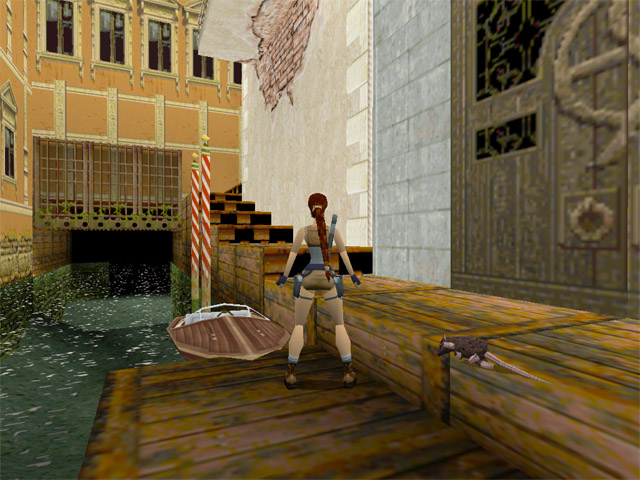
Resident Evil 4(2005), Capcom
Metal Gear Solid 3(2005), Konami
Tomb Raider 2(1996), Core Design, Eidos
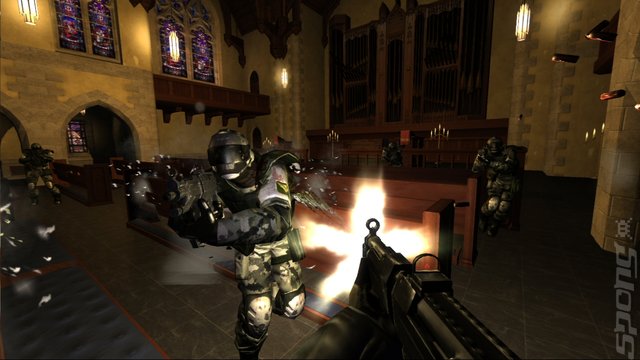
First Person Perspective:
Duke Nukem 3D (1996), 3DRealms
F.E.A.R. (2005), Monolith, Sierra Entertainment
Call of Duty 4: Modern Warfare(2007), IW, Activision
This will serve as the development blog of Project Scarlet Rain. I will post development updates & screenshots, as well as embedding walkthrough videos from youtube.